How Brands Should Evaluate Sports Sponsorships in India
Sports sponsorship in India has moved well beyond putting a logo on a jersey. With the sports economy past ₹18,800 crore and cricket taking 89% of it, brands need to evaluate rights quality, audience fit, activation cost and business outcomes — not just reach.
- Author
- Faiz AsmalFounder, Magnivox Media Solutions
- Published
- Reading time
- 8 min read
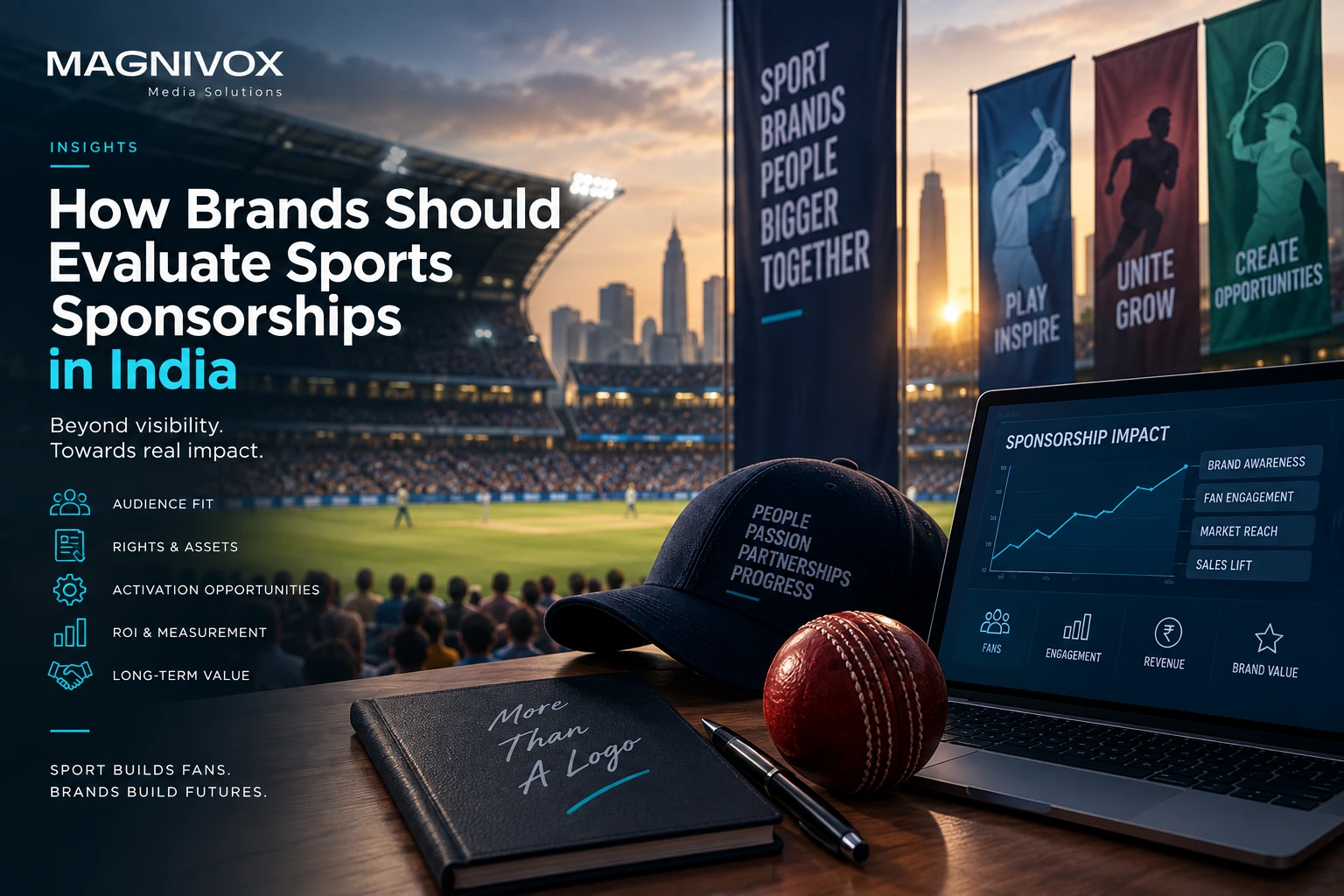
Sports sponsorship in India has moved well beyond putting a logo on a jersey.
The Indian sports economy crossed the ₹18,800 crore mark in 2025, according to WPP Media, growing 13.4% year on year. Cricket accounted for 89% of the overall sports economy, while sports sponsorship itself reached approximately ₹7,943 crore.
Those numbers explain why brands continue to invest heavily in sports.
But they also create a problem.
More brands are competing for the same premium properties, while the cost of getting noticed around those properties continues to rise.
The question therefore shouldn't simply be:
"How many people will see my logo?"
It should be:
"What business outcome can this property help me create?"
That is a very different way of evaluating sponsorship.
Reach is only the starting point
For years, sponsorship proposals have largely been evaluated around audience numbers.
- TV reach.
- Digital impressions.
- Stadium attendance.
- Social followers.
- Media value.
All of these numbers matter. None of them, by themselves, tell you whether a sponsorship is going to work.
Imagine two properties delivering similar reach.
One gives your brand naming rights, content access, athlete integration, hospitality and digital amplification.
The other gives you a perimeter board and a few social media posts.
The media numbers may look similar on paper.
The marketing opportunity isn't.
Start with the business objective
Before looking at a property, define what the brand is trying to achieve.
Is the objective:
- Brand awareness?
- Market entry?
- Product launch?
- Premiumisation?
- Distribution?
- Lead generation?
- Consumer engagement?
- B2B relationships?
- Youth relevance?
- Regional penetration?
- Corporate reputation?
Different objectives require different sports properties.
A national consumer brand may benefit from mass cricket exposure.
A regional business may get greater value from a property with a concentrated local audience.
A technology company might be more interested in content and digital integrations than static visibility.
A financial services brand may place greater value on hospitality and customer acquisition opportunities.
The sport isn't the strategy. The sport is the platform.
Evaluate the audience, not just the audience size
One of the biggest mistakes brands make is treating every impression as equal.
It isn't.
A sponsorship reaching 100 million people isn't automatically better than one reaching 30 million.
Ask: Who are those people?
Look at:
- Age
- Gender
- Geography
- Income
- Consumption behaviour
- Category affinity
- Digital behaviour
- Purchase intent
- Brand relevance
The right question isn't "How many fans does this property have?"
It's:
"How many of the right people does this property give us access to?"
Look at the entire rights portfolio
A sponsorship should be evaluated as a package of marketing assets. Consider:
Brand visibility
Where does the brand appear?
- Jersey?
- Stadium?
- Broadcast?
- Digital?
- Social?
- On-ground?
Content rights
- Can the brand create original content?
- Can athletes or teams participate?
- Can footage be used in advertising?
- Can the partnership generate short-form content throughout the year?
Activation rights
- Can the brand actually interact with fans?
- Can you build experiences around the property?
- Can consumers participate rather than simply watch?
Hospitality
Can the property help strengthen relationships with customers, distributors, partners and employees?
Media amplification
How much additional media investment will be required to make the sponsorship visible?
This last point is often underestimated.
Calculate the amplification cost
A ₹10 crore sponsorship isn't necessarily a ₹10 crore campaign.
There is usually an additional cost associated with:
- Creative development
- Media
- Influencers
- Content
- Digital amplification
- Events
- PR
- OOH
- Retail activation
- Production
- Talent
Brands should therefore evaluate total activation cost, not simply rights cost.
A useful internal framework is:
Total Sponsorship Investment = Rights Fee + Activation + Media + Content + Measurement
Only then can the brand understand the real economics of the partnership.
Measure more than media value
Media value has its place. But sponsorship measurement should move toward business outcomes.
Depending on the objective, measurement could include:
| Brand | Engagement | Commercial | Relationship |
|---|---|---|---|
| Awareness | Video views | Leads | Customer acquisition |
| Consideration | Content completion | Sales | Dealer engagement |
| Preference | Social interactions | App downloads | B2B meetings |
| Brand association | Participation | Store visits | Hospitality utilisation |
| Website traffic | |||
| Conversion |
The measurement framework should be established before the sponsorship begins.
Otherwise, brands often end up measuring whatever data the rights holder happens to provide.
Don't ignore emerging sports
Cricket remains overwhelmingly dominant, but the Indian sports ecosystem is becoming more diversified.
WPP Media reported that cricket represented 89% of India's sports economy in 2025, meaning there is still a huge concentration around the sport. At the same time, professional leagues and other sporting ecosystems continue to develop.
For brands, emerging sports can create a different proposition. There may be:
- Lower entry costs
- Less clutter
- Stronger category association
- More meaningful fan relationships
- Greater access to athletes
- Opportunities to own a narrative earlier
The objective shouldn't be to move away from cricket.
It should be to understand when cricket is right and when another property may solve the marketing problem more effectively.
The five-question sponsorship test
Before signing a sponsorship agreement, every brand should be able to answer five questions:
- 01Why this sport? — What consumer connection does it create?
- 02Why this property? — What does this particular league, team, tournament or athlete offer?
- 03Why us? — Why is the partnership credible for the brand?
- 04What will we do with it? — What is the activation strategy?
- 05How will we know it worked? — What business and marketing metrics will determine success?
If those five answers aren't clear, the sponsorship probably isn't ready.
The future of sports sponsorship is integration
The most effective sponsorships will increasingly sit inside a broader marketing ecosystem.
The sponsorship becomes the platform.
- Media creates reach.
- Content creates storytelling.
- Influencers create relevance.
- OOH creates visibility.
- Digital creates performance.
- Events create participation.
- CRM creates retention.
That is where sponsorship starts becoming more than a logo placement.
It becomes a growth engine.
Magnivox point of view
At Magnivox, we believe sports sponsorship and partnerships should be evaluated as a marketing investment rather than an inventory purchase.
The right property isn't necessarily the one with the biggest audience.
It's the one where the audience, rights, brand story, activation opportunity and business objective intersect.
That is where sponsorship creates value.
Let's Talk
Have a marketing challenge you're trying to solve? Let's build the right strategy around it.
Planning your next sports partnership? Talk to Magnivox about evaluating the property, rights, activation and media opportunity before you invest.
Talk to MagnivoxSources
Keep reading
You may also like.
Media & Advertising
Why Media Planning Needs to Become More Integrated
Faiz Asmal7 min read
Read Article
Marketing & Strategy
What 360° Marketing Really Means for Modern Brands
Faiz Asmal7 min read
Read Article
Influencer & Creator Marketing
Influencer Marketing: Why Follower Count Is No Longer Enough
Faiz Asmal7 min read
Read Article