Why Media Planning Needs to Become More Integrated
Consumers don't experience brands channel by channel — they simply move through their day. With India's advertising market at ₹1.11 lakh crore and digital at 44%, the media plan has to become as integrated as the consumer journey it is trying to shape.
- Author
- Faiz AsmalFounder, Magnivox Media Solutions
- Published
- Reading time
- 7 min read
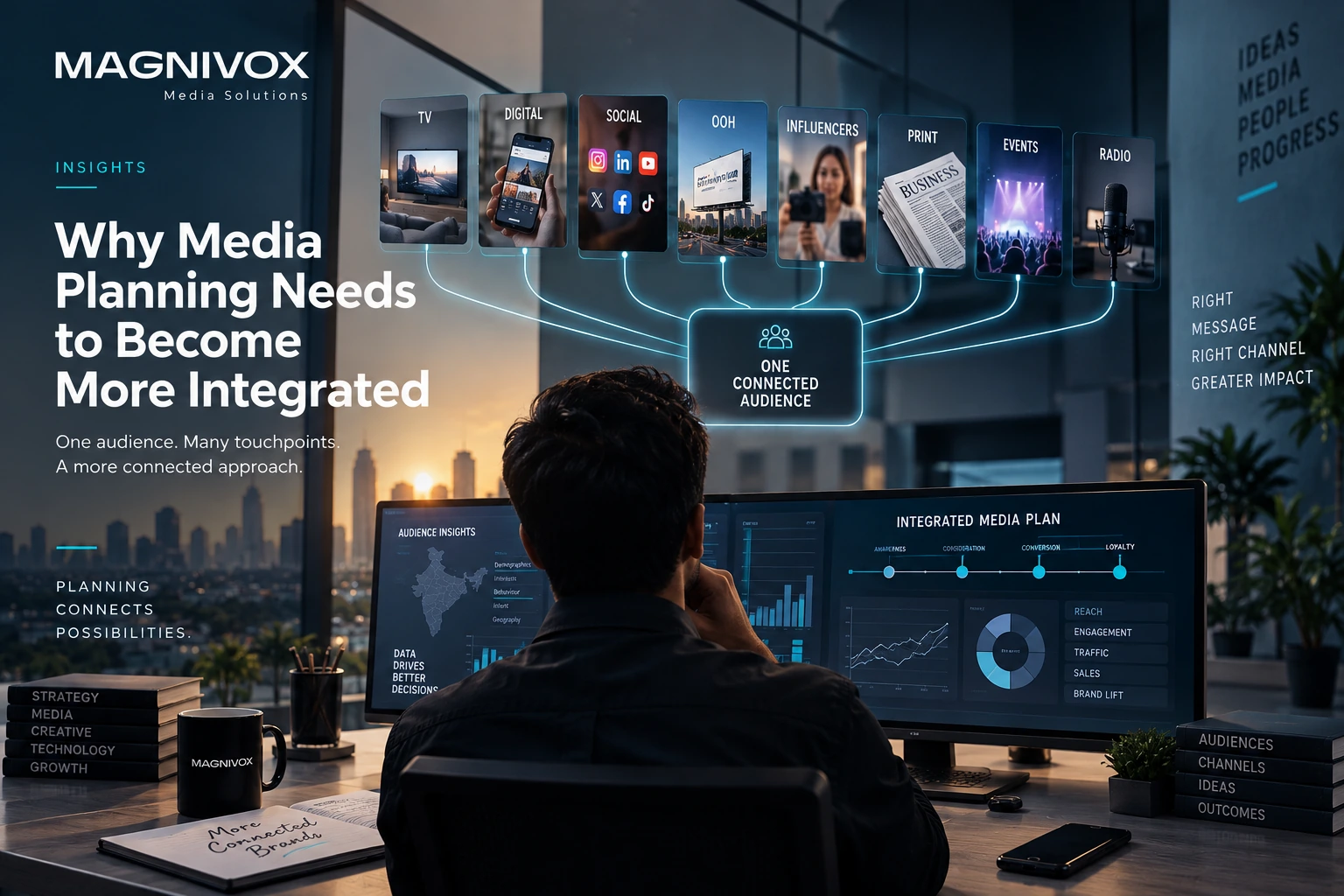
There was a time when a media plan could be neatly divided into television, print, radio, outdoor and digital.
Today, consumers don't experience brands that way.
They don't think: "I am now consuming television, followed by digital, followed by OOH."
They simply move through their day.
- They see an Instagram Reel in the morning.
- Search for a product during lunch.
- See an outdoor billboard on the way home.
- Watch a YouTube video at night.
- See a connected TV advertisement later.
- Then ask an AI assistant about the brand.
The consumer journey is integrated. The media plan should be too.
India's advertising market reached approximately ₹1.11 lakh crore in FY2025, according to the ET Brand Equity-Ipsos report. Digital accounted for 44% of the market, television 27%, print 18%, OTT 5% and OOH 3%.
| Medium | Share of India's advertising market, FY2025 |
|---|---|
| Digital | 44% |
| Television | 27% |
| 18% | |
| OTT | 5% |
| OOH | 3% |
The numbers show how fragmented the ecosystem has become.
But fragmentation doesn't mean marketers should plan in silos.
It means integration matters more.
The old media planning model
Traditionally, a campaign might be planned like this:
- TV team → television
- Digital team → digital
- OOH team → outdoor
- PR team → earned media
- Social team → social
- Influencer team → creators
Each team has its own objectives. Each has its own budget. Each produces its own report.
The problem is obvious.
The consumer doesn't experience these channels independently.
The brand should therefore stop asking: "How much should we spend on digital?"
and start asking:
"What role should digital play in the consumer journey?"
That is a much better planning question.
Integration doesn't mean putting everything together
This distinction matters.
Integrated media planning doesn't mean taking ₹100 and putting ₹20 into five different channels.
For example:
| Channel | Job in the plan |
|---|---|
| Television | Create mass awareness. |
| OOH | Create physical visibility and reinforce memory. |
| Digital video | Build frequency and storytelling. |
| Search | Capture existing intent. |
| Social | Create conversation. |
| Influencers | Build credibility and relevance. |
| Performance media | Convert demand. |
| CRM | Retain and grow customers. |
The channels work together. They don't compete with each other.
The six-touchpoint consumer
Consumers increasingly encounter brands across multiple environments.
A person may discover a brand through social media, encounter it on OOH, search for it on Google, watch a product review, visit the website and finally purchase.
The important question becomes:
How do these touchpoints reinforce one another?
That is the job of integrated planning.
Data should connect the plan
One of the biggest opportunities is connecting data across channels.
Instead of reporting:
- TV delivered X reach.
- Digital delivered Y impressions.
- OOH delivered Z estimated views.
The marketer should ask: What happened to the consumer after exposure?
- Did search increase?
- Did branded website traffic rise?
- Did social engagement increase?
- Did store visits increase?
- Did conversion rates change?
- Did consideration improve?
This is where media planning starts moving toward marketing intelligence.
Digital isn't automatically the answer
Digital has grown rapidly in India.
According to Ipsos, digital advertising reached 44% of India's total advertising market in FY2025, overtaking television.
But digital dominance doesn't mean every brand should become digital-only.
- A consumer brand launching in a new city may need OOH.
- A premium brand may need print and experiential environments.
- A mass brand may need television.
- A B2B brand may benefit from LinkedIn, events and content.
The correct mix depends on the audience and objective.
OOH and digital are becoming complementary
Consider a simple example.
- 01A consumer sees a brand message on an airport billboard.
- 02Later, they search for the brand.
- 03They see a YouTube video.
- 04They visit the website.
- 05They are retargeted with a product offer.
The outdoor impression wasn't isolated. It became part of a sequence.
This is how modern media should be planned.
The role of AI
AI is also changing planning.
Planning systems can increasingly process:
- Audience behaviour
- Search trends
- Creative performance
- Media costs
- Geographic data
- Conversion patterns
- Consumer sentiment
But AI doesn't eliminate strategy. It makes strategic thinking more important.
A machine can identify correlations. The marketer still needs to determine:
What should the brand say, to whom, where and why?
Build campaigns around consumer moments
Instead of starting with media channels, start with moments. For example:
| Moment | Channels that serve it |
|---|---|
| Discovery | Social + creators + OOH |
| Research | Search + content + reviews |
| Consideration | Video + retargeting + website |
| Conversion | Performance + retail + CRM |
| Retention | CRM + social + content |
This approach creates a connected journey.
Measurement needs to change too
Integrated planning requires integrated measurement.
A dashboard shouldn't only show reach, CPM, CTR, views and frequency.
It should connect media metrics with business metrics. A more useful framework is:
Exposure → Engagement → Intent → Action → Value
This helps management understand not just how much media was purchased, but what the media contributed.
Magnivox point of view
At Magnivox, we believe the future of media planning and buying is not television versus digital or OOH versus social.
The future is orchestration.
Every channel has a role. The planner's job is to make those roles work together.
The best media plan isn't necessarily the one with the most channels.
It's the one where every channel contributes to the same consumer journey.
Let's Talk
Have a marketing challenge you're trying to solve? Let's build the right strategy around it.
Want to build a media plan around consumer behaviour instead of channel silos? Speak to Magnivox.
Talk to MagnivoxSources
Keep reading
You may also like.
Marketing & Strategy
What 360° Marketing Really Means for Modern Brands
Faiz Asmal7 min read
Read Article
Sports & Partnerships
How Brands Should Evaluate Sports Sponsorships in India
Faiz Asmal8 min read
Read Article
Digital & Discovery
SEO, AEO and GEO: How Brand Discovery Is Changing
Faiz Asmal8 min read
Read Article