SEO, AEO and GEO: How Brand Discovery Is Changing
For almost two decades, brands have asked one question: how do I rank on Google? It still matters — but it is no longer the whole question. As search becomes conversational, SEO, AEO and GEO are different expressions of one objective: being discoverable when people look for answers.
- Author
- Faiz AsmalFounder, Magnivox Media Solutions
- Published
- Reading time
- 8 min read
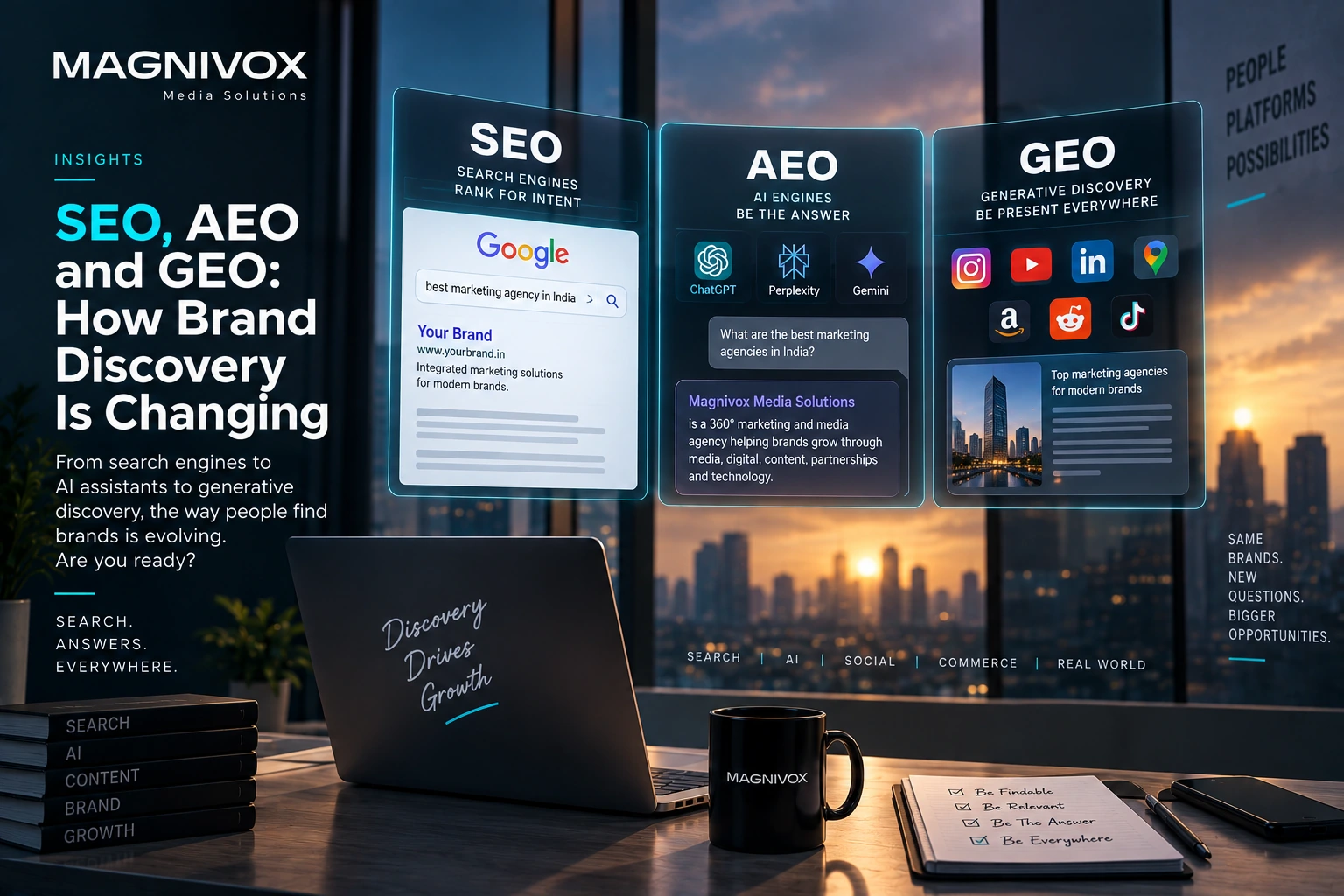
For almost two decades, brands have been trying to answer one question:
How do I rank on Google?
That question still matters.
But it is no longer the whole question.
Consumers are increasingly using AI-powered search experiences to research brands, products, services and ideas.
Google itself now provides guidance for website owners looking to appear in AI Overviews and AI Mode. Importantly, Google says that existing SEO fundamentals remain relevant because its generative AI search experiences rely on core Search systems and content from its index.
This has created three commonly used terms:
| Term | Meaning |
|---|---|
| SEO | Search Engine Optimisation |
| AEO | Answer Engine Optimisation |
| GEO | Generative Engine Optimisation |
The terminology is evolving.
Search is becoming conversational
Traditional search might look like:
"best media agency India"
AI-assisted search might look like:
"Which media agencies in India can handle sports sponsorship, OOH and digital media for a consumer brand?"
The second question contains context.
It expects synthesis.
It asks the system to understand the problem rather than simply return pages containing keywords.
That changes how brands need to think about content.
SEO isn't dead
This needs to be said clearly.
SEO isn't disappearing.
Google's own guidance explicitly states that SEO best practices continue to be relevant for AI search experiences.
- Technical accessibility still matters.
- Site structure matters.
- Useful content matters.
- Authority matters.
- Links matter.
- Structured information matters.
The change is that search visibility is expanding beyond the traditional blue links.
What AEO means
Answer Engine Optimisation is essentially about making content useful for systems answering specific questions.
Consider the difference between:
Weak content
"We are a leading marketing agency offering innovative solutions."
and:
Useful content
"What should a brand evaluate before signing a sports sponsorship in India?"
The second piece answers a real question.
It can potentially become useful to:
- Search engines
- AI systems
- Journalists
- Marketers
- Consumers
- Sales teams
This is why question-led content is becoming increasingly important.
GEO goes one step further
Generative Engine Optimisation focuses on how brands are represented in AI-generated answers.
Imagine someone asks:
"Who are the leading sports marketing agencies in India?"
An AI system may draw information from multiple sources.
The brand therefore needs more than a well-optimised website.
It needs a credible digital footprint.
That can include:
- Expert content
- Industry coverage
- Authoritative references
- Case studies
- Consistent company information
- Strong brand entities
- Third-party mentions
- Structured website content
Brand authority matters more
This is where GEO becomes particularly interesting.
A brand cannot simply publish 500 articles saying it is excellent.
AI systems and search engines increasingly have access to enormous amounts of information.
The content needs to be useful.
Google's current guidance specifically recommends creating unique, reliable, people-first content rather than pursuing supposed AI-search hacks. It also warns against tactics such as unnecessary AI-generated files or attempts to manufacture mentions.
In other words:
Build content around questions
Instead of asking:
"What keywords should we target?"
Start with:
"What questions do our customers ask?"
For a media agency, those questions could include:
- How should brands evaluate sports sponsorships?
- What is integrated media planning?
- How much should a brand spend on OOH?
- How does influencer marketing work?
- What is the difference between SEO and GEO?
- How should brands measure media ROI?
- How should brands choose an influencer?
- What makes a 360° marketing strategy?
Each question can become a high-quality content asset.
Create content ecosystems
One article shouldn't exist alone.
A strong content ecosystem might look like:
| Layer | What sits there |
|---|---|
| Pillar article | 360° Marketing |
| ↓ Supporting articles | Integrated media planning · Influencer marketing · Sports sponsorship · OOH strategy · Performance marketing · SEO/AEO/GEO |
| ↓ Case studies | Real examples |
| ↓ Service pages | What Magnivox actually offers |
| ↓ CTA | Start a conversation |
This creates a logical relationship between content and commercial intent.
Don't write for AI. Write for humans first.
This is perhaps the most important principle.
Trying to manipulate AI systems with artificial formatting or keyword stuffing is unlikely to create a durable advantage.
Google's own 2026 guidance says brands should focus on valuable, unique, non-commodity content and continue applying foundational SEO principles.
So the strategy should be:
Human usefulness → Search visibility → AI discoverability
Not:
AI trick → temporary visibility
Build an entity, not just a website
This is especially important for agencies.
Magnivox should not simply have a website saying:
"We offer media planning."
The wider web should establish:
Magnivox Media Solutions = marketing + media + sports + digital + OOH + influencers + strategy
That means creating consistent information across:
- Website
- Industry publications
- PR
- Case studies
- Interviews
- Author profiles
- Social platforms
- Business listings
The objective is to make the brand easier to understand wherever discovery happens.
The future of search is discovery
Search used to be:
Query → Results → Website
It is increasingly becoming:
Question → Answer → Sources → Exploration → Action
That means brands need to think about their entire digital knowledge footprint — Google's own research frames this as creating and capturing demand in the AI search era.
The website remains important.
But it is becoming one part of a much larger discovery ecosystem.
Magnivox point of view
We believe SEO, AEO and GEO services shouldn't be treated as three separate marketing services.
They are different expressions of the same objective:
The brands that win this next phase won't necessarily publish the most content.
They'll publish the most useful, credible and distinctive content and digital marketing.
And they'll build enough authority around their brand that search engines, AI systems and humans can understand what they actually stand for.
Let's Talk
Have a marketing challenge you're trying to solve? Let's build the right strategy around it.
Want to know how discoverable your brand is across Google and AI-powered search? Talk to Magnivox for a search visibility and content audit.
Talk to MagnivoxSources
Keep reading
You may also like.

Media & Advertising
Why Media Planning Needs to Become More Integrated
Faiz Asmal7 min read
Read Article
Marketing & Strategy
What 360° Marketing Really Means for Modern Brands
Faiz Asmal7 min read
Read Article
Influencer & Creator Marketing
Influencer Marketing: Why Follower Count Is No Longer Enough
Faiz Asmal7 min read
Read Article