What 360° Marketing Really Means for Modern Brands
Put television, digital, influencers, outdoor, PR and events into one presentation and it gets called a 360° strategy. That's a list of services. True 360° marketing is one connected brand and consumer journey — with each channel doing a distinct job.
- Author
- Faiz AsmalFounder, Magnivox Media Solutions
- Published
- Reading time
- 7 min read
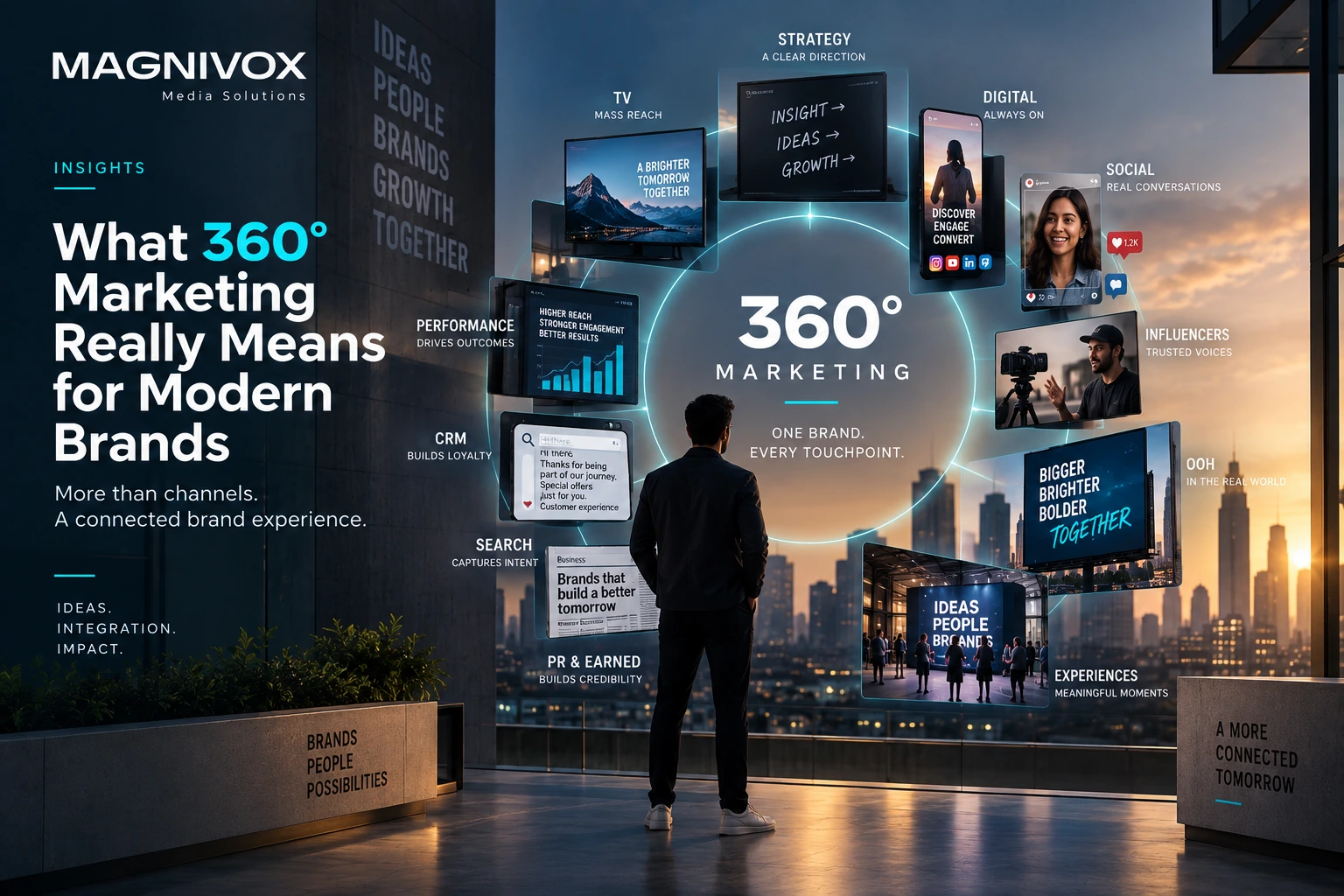
The phrase "360° marketing" has been used so often that it has almost lost its meaning.
Put television, digital, social media, influencers, outdoor, PR and events into one presentation and suddenly it's called a 360° strategy.
But that's not 360° marketing.
That's a list of services.
And that distinction matters.
The consumer doesn't live in channels
Think about a normal purchase journey.
- 01A consumer discovers a product on Instagram.
- 02They search Google.
- 03They watch a review.
- 04They see the brand on an outdoor billboard.
- 05They visit the website.
- 06They compare competitors.
- 07They ask a friend.
- 08They see an influencer talking about it.
- 09Then they purchase.
- 10Afterwards, they receive an email or WhatsApp message.
That is one consumer journey.
The channels are different. The consumer isn't.
What 360° actually means
A genuine 360° marketing strategy should connect five things:
| Element | The question it answers |
|---|---|
| 1. Strategy | What does the brand stand for? |
| 2. Audience | Who are we trying to influence? |
| 3. Communication | What should we say? |
| 4. Distribution | Where should people encounter the message? |
| 5. Measurement | What happened as a result? |
Without these five elements, the campaign becomes fragmented.
The danger of agency silos
A company might have:
- A digital agency.
- A media agency.
- A PR agency.
- An influencer agency.
- An events agency.
- An OOH agency.
- A creative agency.
There is nothing inherently wrong with this model.
The problem happens when nobody owns the consumer journey.
One agency creates the campaign. Another buys media. Another manages creators. Another handles PR. Another handles events.
And the brand team becomes the traffic controller between all of them.
This creates duplication, inconsistent messaging and slow decision-making.
The answer isn't necessarily one agency
This is important.
360° marketing doesn't automatically mean one agency must execute everything.
The more important question is:
Who is connecting the pieces?
A strong marketing partner should be capable of seeing across disciplines. That means understanding:
- How a television campaign affects search.
- How an influencer campaign affects content.
- How OOH affects brand recall.
- How sponsorship creates content opportunities.
- How PR creates credibility.
- How performance marketing captures demand.
Build around the customer funnel
A useful 360° framework is:
| Stage | Channels that serve it |
|---|---|
| Reach | TV + OOH + digital video + social |
| Interest | Creators + content + PR |
| Consideration | Search + website + reviews + comparison content |
| Conversion | Performance marketing + retail + sales |
| Retention | CRM + community + content |
The key is that each layer supports the next.
Creative and media can't be separated
One of the biggest mistakes in modern marketing is developing creative first and figuring out media later.
The creative idea should understand the environment in which it will live.
- A six-second video is different from a billboard.
- A billboard is different from an Instagram Reel.
- A YouTube creator integration is different from television.
360° marketing is increasingly measurable
Digital has changed expectations. Marketers now want to know what happened after an impression.
That doesn't mean every channel needs a last-click conversion metric. Brand building and performance serve different purposes.
But they should ultimately contribute to a common measurement framework. For example:
| Layer | Measures |
|---|---|
| Brand | Awareness, consideration, preference |
| Engagement | Views, interactions, content consumption |
| Intent | Searches, website visits, enquiries |
| Conversion | Sales, leads, transactions |
| Retention | Repeat purchase, CRM engagement, customer value |
The AI layer
AI is adding another dimension.
Consumers are increasingly discovering information through AI-enabled search experiences.
Google's current guidance is particularly relevant here: its AI search features continue to rely on foundational SEO, useful content and Google's existing quality systems.
This means 360° marketing now extends beyond traditional media. Brands also need to think about:
"Can people find, understand and trust us when they ask an AI system about our category?"
That's a new brand touchpoint — and it is why digital marketing now has to include how a brand appears in AI-generated answers, not only in search results.
The new definition of 360°
My definition is simple:
It isn't about doing everything.
It's about connecting what matters.
Magnivox point of view
At Magnivox, we don't believe brands need more disconnected marketing activity.
They need better-connected marketing thinking. That is how we build our 360° marketing and media solutions.
- Strategy should inform creative.
- Creative should inform media.
- Media should inform content.
- Content should create engagement.
- Engagement should create intent.
- Intent should create business outcomes.
That's what 360° should mean.
Let's Talk
Have a marketing challenge you're trying to solve? Let's build the right strategy around it.
If your marketing is being managed in silos, let's map the entire consumer journey and identify where the gaps are.
Talk to MagnivoxSources
Keep reading
You may also like.
Media & Advertising
Why Media Planning Needs to Become More Integrated
Faiz Asmal7 min read
Read Article
Sports & Partnerships
How Brands Should Evaluate Sports Sponsorships in India
Faiz Asmal8 min read
Read Article
Influencer & Creator Marketing
Influencer Marketing: Why Follower Count Is No Longer Enough
Faiz Asmal7 min read
Read Article